
Second Brain, Daily Review, and the Case for Modular Cognitive Infrastructure
By Charles Villarreal
March 27, 2026
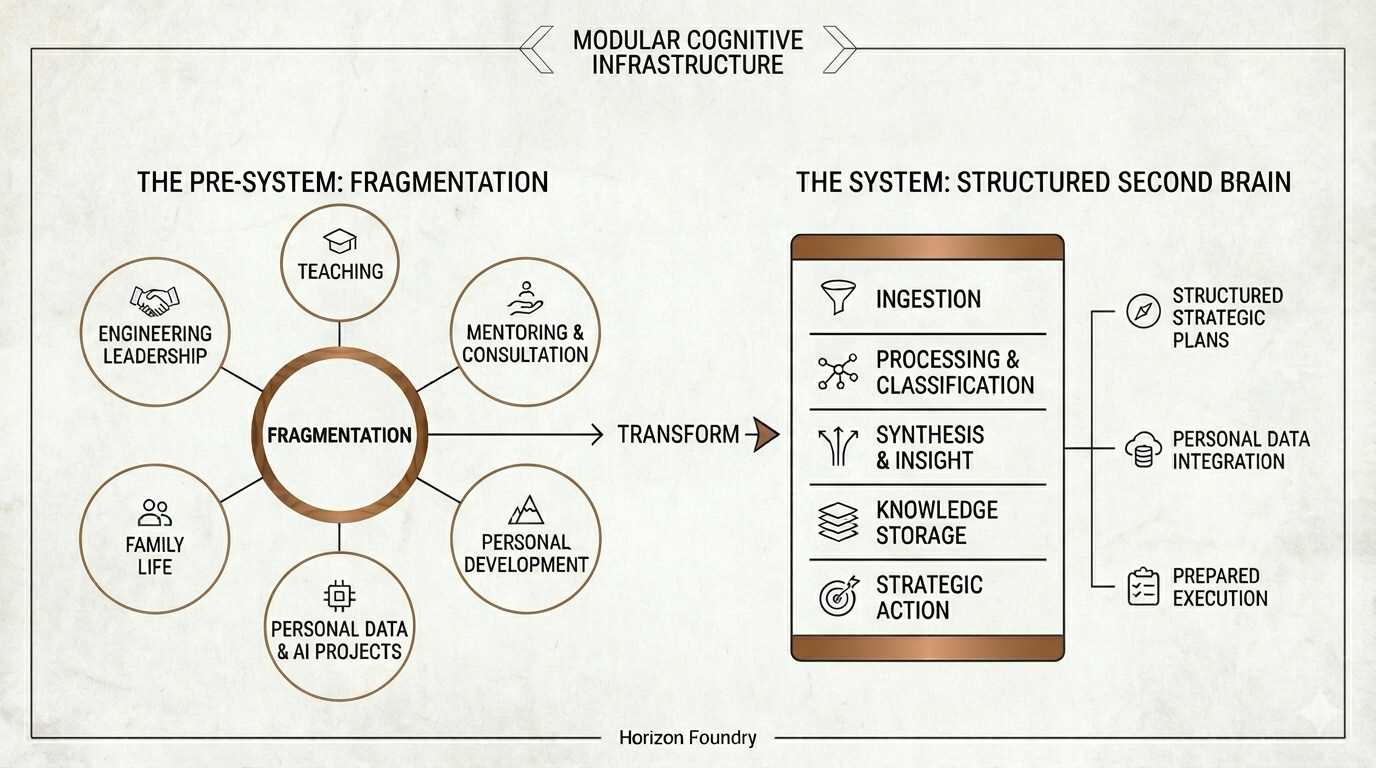
A few years ago, I started to feel the cost of fragmentation more sharply.
Part of that came from work. I lead two engineering teams with very different rhythms, one centered on data engineering and platform operations, the other on AI capabilities, automation, and emerging agentic workflows.
But work was only part of the equation.
I also teach graduate courses. That means facilitating active classes, grading, answering questions, holding office hours, and getting to know students well enough to be genuinely useful to them. I mentor newer professionals in the field. Occasionally folks reach out for advice or consultation. Tending to my own development is not an afterthought, it is a standing commitment. I read white papers and books, listen to podcasts, run my own research threads, and do personal data and AI work to keep my skills sharp. I spend real time studying behavioral science and leadership because technology only takes a person so far. I also try to stay conversant beyond data and AI because I have no interest in becoming a one-trick pony in a field that changes every quarter.
And then there is life outside work. I have a family of six, with a working spouse and kids ranging from elementary school to a college freshman. The family calendar has its own gravity.
The problem was never simply that I was busy.
The problem was fragmentation.
Useful context was scattered across calendars, inboxes, tickets, chat threads, documents, notebooks, half-formed ideas, and memory. The pace of change made it worse. It became harder to recover context quickly, accurately, and consistently. Some of what mattered was formal. Some of it lived in the small signals that are easy to notice in the moment and easy to lose three days later.
As the field accelerated, ordinary habits stopped being enough. I needed a system that could help me stay oriented across leadership, teaching, learning, mentoring, and life without forcing me to reconstruct reality from scratch every day.
So I built one.
I called it Second Brain.
Second Brain began as a practical response to a real operating problem. As I worked on it, I realized it could create value across multiple parts of my life and work. It became a place to explore architectures I believed would matter more over time. It gave me room to work with knowledge ingestion, chunking, embedding, retrieval, and AI workflows. But those visible pieces turned out to be only the thinnest slice of the real system.
Beneath that surface were deeper questions.
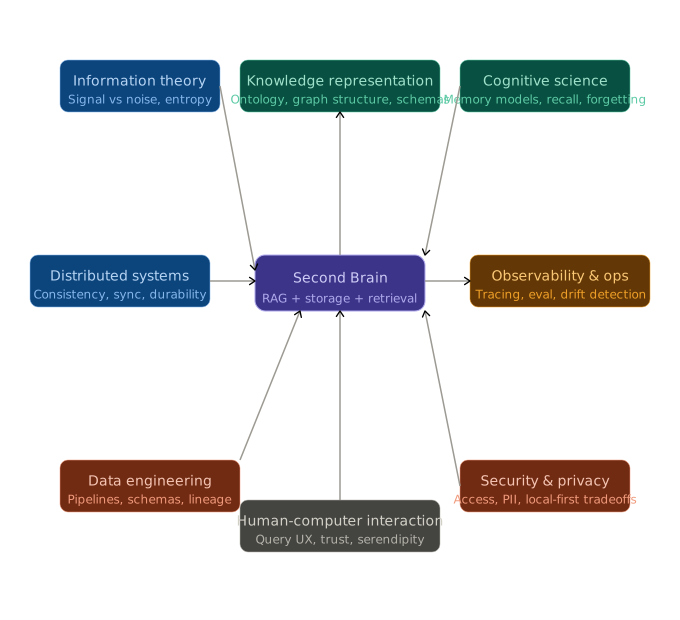
How do you preserve signal without drowning it in filler? What counts as relevance in a corpus that spans notes, articles, meetings, and projects? When should something resurface? What belongs in a vector store, what belongs in structured metadata, and what needs relationships a graph would model better? How do you handle consistency across ingestion, indexing, and query layers? What does observability look like when the system is personal but the architecture behaves like a production stack?
At first glance, these look like machine learning questions. Look closer and they become something broader. They are information theory questions, knowledge representation questions, cognitive science questions, distributed systems questions, data engineering questions, and human-computer interaction questions. The through-line is simple: this is not just an ML project. It is a system, with the same kinds of tradeoffs, blind spots, and operational concerns that show up in more traditional software and data platforms.
I never approached the problem as someone who believed high technology was the only answer.
I use a Bullet Journal. A small notebook is part of my everyday carry. I plan my day with analog cards. I also build with modern AI workflows, retrieval systems, and modular software. I have never been especially interested in technology as a creed. I am interested in what works, what lasts, and what helps me stay useful. That usually leads to a mixed system, not a pure one.
That philosophy shaped Second Brain from the beginning.
I wanted it to be modular. I wanted it to be adaptable. I wanted it to stay valuable even as tools, models, and agent patterns changed. I wanted to avoid locking myself into a specific moment in the stack. The point was to build a system that could evolve without losing the thread.
That design choice paid off quickly.
Pieces of Second Brain revealed obvious applications in my day-to-day leadership work. The same ideas that helped me manage fragmentation across domains turned out to be immediately useful inside the more operational flow of meetings, commitments, tickets, messages, and follow-ups.
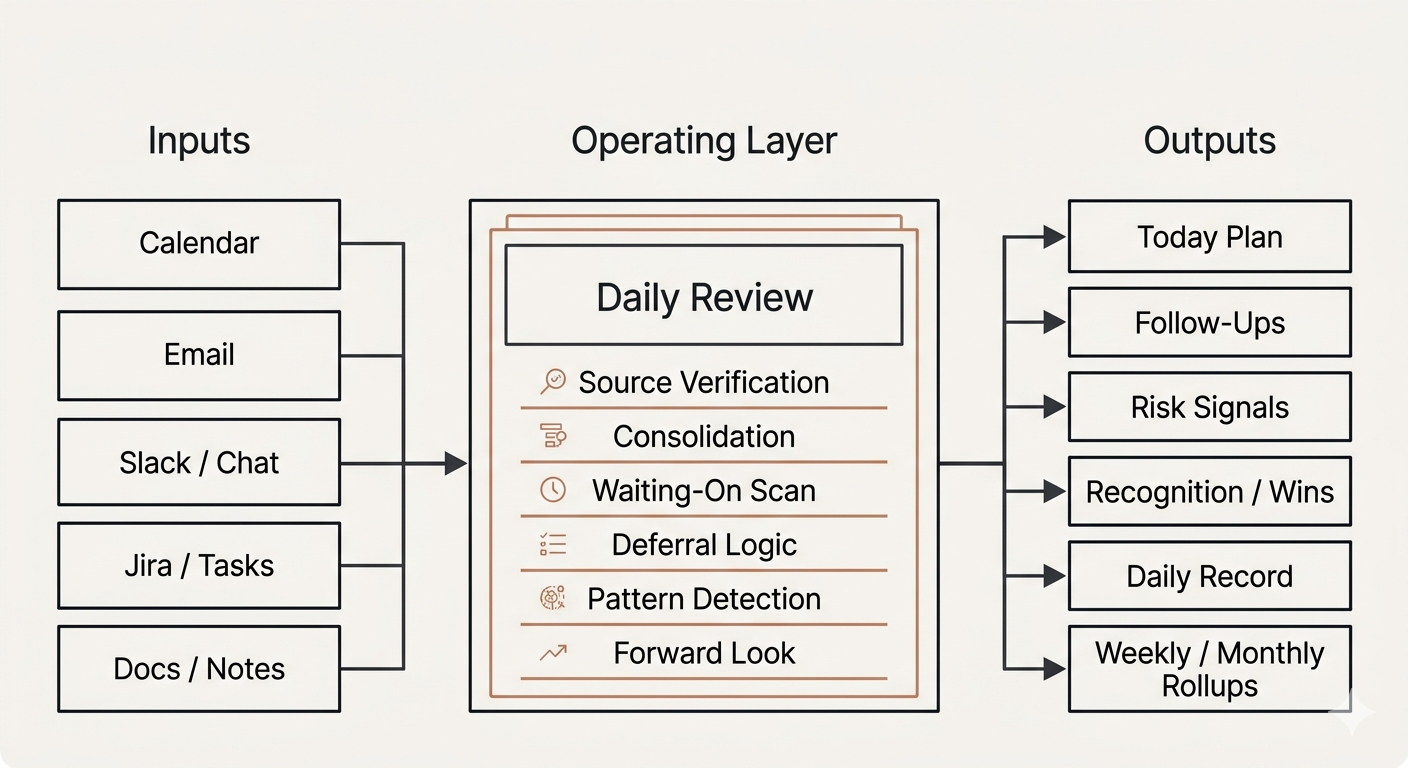
That led to a focused operating layer I currently call the Daily Review.
“Daily Review” is still the name, but the system evolved into something much richer than that label suggests.
It began with a simple question: what mattered today? From there it grew into a source-verified, persistent leadership system that compounds in value over time. It prepares me for the day ahead by pulling together calendar context, open action items, active work, unresolved threads, and waiting-on items. It surfaces risk before it becomes escalation. It helps with relationship management by preserving patterns, obligations, and signals that would never belong in a ticket. It captures specific wins while they are still fresh. It maintains a constrained planning layer, so priority decisions stay honest. It handles deferral with accountability. It also makes returning from time away far less painful. And because it creates a structured record every day, it turns documentation, rollups, and retrospective context into byproducts of the practice rather than separate chores.
One of the most important shifts was realizing that Daily Review was becoming more useful as a forward-looking system than as a backward-looking one.
A lot of review systems are built to document the past. That matters, and as an old-school data nerd, I value a good archive. But one of my favorite things about Daily Review is that it helps me look ahead. It helps me walk into meetings prepared. It helps me identify needed follow-ups before they slip. It helps me manage relationships with more intention. It helps me see risks while there is still time to act. It helps me trace the evolution of a project without guessing. It helps me spot drift early, before it hardens into confusion, delay, or rework.
That is what makes the system feel less like a review and more like infrastructure.
And that, for me, is the larger point.
I set out to build a flexible system that could help me operate effectively while maintaining my sanity across leadership, teaching, mentoring, learning, and life in a field where context decays quickly and change arrives faster every year.
Second Brain was the broader proving ground. Daily Review became one operational expression of that broader architecture.
Both continue to evolve.
That is part of the design.
I do not want a frozen workflow built around a passing toolset. I want modular systems that can absorb change while continuing to solve real problems in the present. I want systems that reduce the cost of reorientation, preserve context, support judgment, and make it easier to follow through on what matters. I want to reduce friction. Above all, I want the result to create real value.
That is the kind of infrastructure I want to keep building.
In later posts, I’ll go deeper into the technical architecture behind Second Brain, why Daily Review organically outgrew its name, and what building systems like this has taught me about learning, leadership, and durability.